Benefits of the Master’s in Translation & Language Industries (at ISTI, Brussels)

Today’s guest post by Elyas is another instalment in the ongoing MA review series. So far 11 former students of MAs in Europe have written about their courses in 8 articles. Before Christmas there’ll be another two posts on the MAs at Swansea and Leeds. If you have studied an MA and would like to share your experience, please get in touch (my email address is in the right margin). See this page for more details about writing for this blog.

Continue reading

My Master’s Degree in Translation and Language Industries at ISTI (ULB)

Celine LemaireI started my translation studies at ISTI (the Institut Supérieur de Traducteurs et Interprètes, which is now part of the ULB, the Université Libre de Bruxelles) in Brussels, five years ago. After three years of a Bachelor’s degree in this department and an Erasmus at UEV in Valencia (Spain), I had fallen in love with translation and decided to continue my Master’s degree at ISTI (ULB).

At the beginning of the first year of the Master’s programme, students can choose between a career in translation or interpreting. Personally, having always loved writing, I made the decision to study an MA in translation.

Continue reading

Bite-sized Tips No. 22: Spellings Part 17 – The Dragon Agrees

Green DragonIn no. 20 of this series, Watch out for the Dragon, I started highlighting some differences between what Dragon NaturallySpeaking (DNS) dictates and correct spellings according to the New Oxford Style Manual, which I base both my work and this series on. If I cannot find what I’m looking for in the style manual, I turn to the Oxford English Dictionary (OED).

Continue reading

Purchase Order Checklist

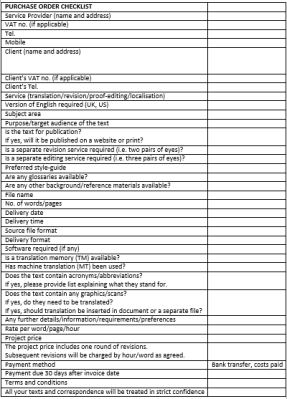
Purchase order checklistMay 2021 update: The purchase order has been updated. Please see this post for 4 new versions of it (for translation, revision, editing and localisation), which you can also download here.

Towards the end of September 2015, I blogged about my ideal purchase order and asked readers for your opinion. I was worried that the form might ask clients to fill in too much information. And most of your comments reinforced that view. You agreed that many would baulk at the idea of providing so many details, even though doing so could save a lot of hassle and misunderstandings later on.

Busy direct clients with little understanding of the translation process are probably better served with a phone call or a few back-and-forth emails to make sure everything is clear. This type of exchange also helps to build a relationship that could lead to future projects. Agency clients, on the other hand, although they are more used to filling in forms, might not know the answers to all the questions and feel reluctant about bothering their end client with them. They also have their own processes in place and wouldn’t appreciate pandering to one of their service providers.

Continue reading

From Standing Out to Standing Up

Andrew Morris Desk 3In today’s guest post Andrew Morris explains why he bought a Varidesk and how it’s changed the way he works (by the way, I’m posting this while standing on my Steppie).

Like most translators, I used to think I was just a head. After all, that’s where it happens, right? We think, we analyse, we transform texts from one language to another. We’re all very cerebral.

Each day as I sat at my desk, I wasn’t even aware of my body. It was just a vehicle for getting my head close enough to the screen to do its work. I fed it and washed it, much like I do my car. But didn’t really give it much TLC.

Continue reading

Selección de recursos para nuevos traductores

Today’s guest post has been written by Yolanda Gómez on behalf of the translation agency she works for, Okodia.
La entrada de hoy la ha escrito Yolanda Gómez de parte de la agencia de traducción para la cual trabaja, Okodia.

Traducción e Interpretación, Periodismo, Medicina, Química, Derecho… Cuando un estudiante finaliza su carrera universitaria y accede al mercado laboral, necesita contar con una serie de recursos, de herramientas útiles para empezar a aprender su oficio “de verdad”. Como decía uno de mis profesores favoritos, un profesional no nace, sino que se hace. Es decir: estudiar una carrera te enseña los fundamentos teóricos de la materia que te interesa, pero a la hora de la verdad necesitas que tus colegas de oficio te orienten, te apoyen y te acompañen en esos primeros pasos en el mundo profesional real.

Continue reading

5 Lessons I Learned While Writing A Book About Interpreting

5 lessons I learnedFor the past few months, I have been working on a draft of my first book, Being a Successful Interpreter: Adding Value and Delivering Excellence. It has been an amazing and sometimes nerve-wracking process that has taught me far more than just writing. In fact, it is no exaggeration to say that I learned as much from the process of writing the book as I did from researching the content. Here are my top five lessons.

Continue reading

LinkedIn Pointers – Part Four: The Other Profile Sections

Welcome to part four of my miniseries on LinkedIn. Last time we looked at the “meaty” main sections of your profile page. Today I’m going to focus on the other sections that you can include to help you describe your services, give details of your qualifications and highlight any other aspects that potential clients might be interested in.

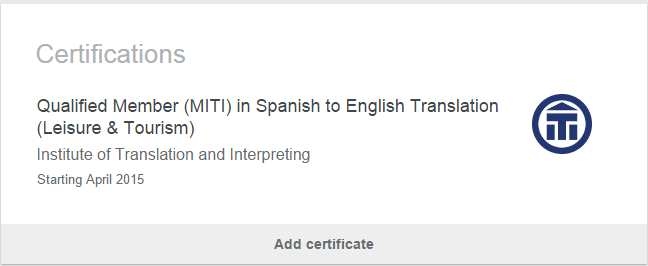
LinkedIn certificationsAs I mentioned last time, you can change the order of the sections on your page to make it your own, emphasise what you feel is relevant and stand out from the crowd (certainly not an easy thing to do these days). At the moment, I’ve decided to put the Certifications section first because I want my potential clients to know that I’ve passed the ITI exam and am, therefore, qualified. You might not agree with my choice, and that’s fine, but I would recommend you fill in this section if you can since, according to LinkedIn, your profile will receive up to six times more views if you do.

Continue reading