The Thorny Subject of Revisions

Receiving a translation back covered in tracked changes and comments is never a nice experience because it mainly signals that the client is unhappy with your work. A mistake is a mistake and has to be owned up to and corrected. It’s something you have to learn from to improve your skills and ensure you don’t repeat. And you have to hope that the consequences won’t be too serious and that you don’t lose the client as a result.

But when there are no errors and the red highlights differences in opinion between the translator and the reviser/editor, it’s a whole other ball game. The ensuing argument can turn into a battle between who is right and who is wrong. And although one may emerge the victor, as in table tennis, points can be won by either player along the way.

Continue reading

Lump it and Like it

A recent argument with an agency about the word count for a job handed in weeks previously has driven home just how sordid this practice of counting words really is. Thankfully, this type of situation doesn’t rear its ugly head that often, and this particular client is not one of my main sources of income. But when an agency forgets I charge by the source word because their arrangements with other translators differ, and they then send a series of short documents as they arrive from the end client with embedded text that the counter in Word doesn’t recognise, problems and tetchy emails can ensue. And I do so loathe any suspicion that I might be trying to pull a fast one by adding more words to the invoice than I am entitled to, especially when the difference we’re squabbling about is a laughably small amount.

Continue reading

Purchase Order Checklist

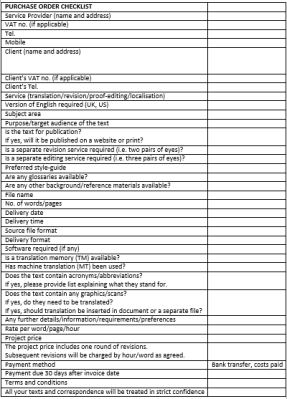
Purchase order checklistMay 2021 update: The purchase order has been updated. Please see this post for 4 new versions of it (for translation, revision, editing and localisation), which you can also download here.

Towards the end of September 2015, I blogged about my ideal purchase order and asked readers for your opinion. I was worried that the form might ask clients to fill in too much information. And most of your comments reinforced that view. You agreed that many would baulk at the idea of providing so many details, even though doing so could save a lot of hassle and misunderstandings later on.

Busy direct clients with little understanding of the translation process are probably better served with a phone call or a few back-and-forth emails to make sure everything is clear. This type of exchange also helps to build a relationship that could lead to future projects. Agency clients, on the other hand, although they are more used to filling in forms, might not know the answers to all the questions and feel reluctant about bothering their end client with them. They also have their own processes in place and wouldn’t appreciate pandering to one of their service providers.

Continue reading

My ideal purchase order: pipe dream or reality?

PO

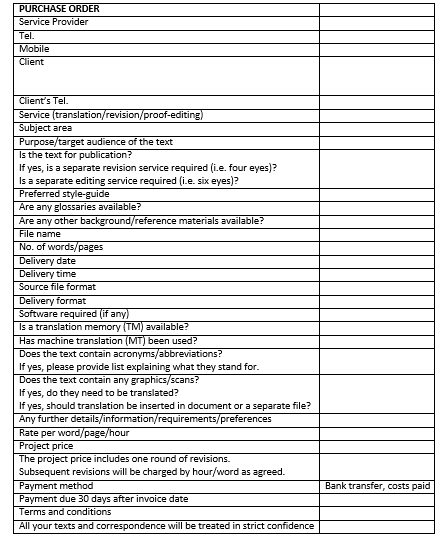
May 2021 update: The purchase order has been updated. Please see this post for 4 new versions of it (for translation, revision, editing and localisation), which you can also download here.

For a while now I’ve been working on the type of purchase order I’d like to give to both my agency and direct clients (especially new ones) so that we all know where we stand and are clear about the price and what it does and does not include. Today I’ve been inspired by reading Two to Tango: Tips for Project Managers from a Freelance Translator (parts 1 and 2) by Igor Vesler on Lingua Greca’s blog to finally finish my first draft. I’m posting it here so I can get your feedback and comments, because I’m a little concerned that it might be overly long and put some clients off.

Continue reading

A few words about using another’s translation for repeat texts

IMG_0898I’m sure many of you can identify with this scenario: an end client sends an agency similar documents on a regular basis and most are largely the same with just a few tweaks needed here and there to incorporate new information. Sometimes this work is handled by agencies that farm the job out to the first available translator, provide them with a TM and tell them not to touch 100% matches (which they don’t pay for). Sometimes the agencies are quite happy for you to alter the TM and pay a sliding-scale revision rate for matches. Other times the agency sends the work to the same translator year after year, who can then use his or her own TM to do the job. However, in the latter case, the one I’m most familiar with, the preferred usual translator is inevitably not always available, so the document is sent to another translator to process along with copies of previous translations.

Continue reading

When should we apply extra charges to translation projects?

Nancy Matis

For some, the answer is obvious. For others, it’s not that easy. I personally think that it is a case-by-case decision, depending not only on you, but also on the client and on the specific project. Let’s try to analyse this sensitive issue.

People usually believe that extra charges should apply for overtime hours, rush deliveries or complex jobs. I don’t think these concepts mean the same thing to each of us. Let’s explore these three points.

Continue reading

La última tendencia en la industria de la traducción: PEMT

PEMT2¿Han escuchado hablar sobre la última tendencia en la industria de la traducción? Se la conoce como PEMT, significa traducción automática con revisión posterior (post-editing machine translation, PEMT*). Hace referencia a cuando los clientes usan un programa para traducir un texto antes de enviárselo a un traductor para que este haga la revisión final. Algunos clientes usan herramientas de traducción automática (TA) más sofisticadas que las que se ofrecen en línea. Sin embargo, según mi experiencia, el Traductor de Google es la herramienta de traducción más popular y, por ese motivo, la que los clientes usan con más frecuencia para obtener una traducción por el precio de una revisión, en general, alrededor de un 50 % menos del costo.

Continue reading

The Latest Trend in the Translation Industry: PEMT

PEMT2Have you heard of the latest trend in the translation industry? It’s called PEMT* and it stands for post-editing machine translation. This is when clients use a program to translate their text before sending it to a translator for the final edit. Some clients use more sophisticated MT (machine translation) than online offerings, but in my experience Google Translate is the most popular translation tool, and, therefore, the one clients use more often than not to get a translation for the price of a revision, usually around 50% of the cost.

Continue reading

Google Translate ¿Un Nuevo Competidor?

Google Translate - RaquelParece una nueva moda. Si fuera una situación que sucede únicamente en España, diría que se trata de casos de “picaresca española”. Cada vez que un cliente me “cuela” un texto para revisar que ha sido traducido por Google Translate (u otro traductor automático) me imagino su cara de satisfacción pensando que me ha metido un gol y que se ha ahorrado un 50% de la tarifa con un simple click del ratón.

Continue reading

Let’s Talk Money

Money Talk2This post is not going to tell you how much to charge for your services, because there’s no such thing as a going rate in translation. The amount you receive for your work will depend on your language pair, the specialism involved (in other words whether it’s a subject you need other qualifications and/or years of experience for), and a whole host of other factors.

there’s no such thing as a going rate in translation

Continue reading