
 Living and working in France for the past 26 years, when it came to choosing a training programme to acquire qualifications in translation I was faced with two criteria:
- to be able to continue my job as I worked towards getting a qualification
- to find a higher-education diploma on the French list of national professional qualifications (RNCP)
My research led me to CI3M*, which met both my criteria. As I contacted them, I discussed the possibility of what is called VAE in France (validation des acquis de l’expérience). This is a system which allows you, based on your experience in a domain, to pass tests to obtain an official qualification. I did not have the three years’ professional activity required to follow this programme. This represents a solution to be looked into for anyone who has been a professional translator in France for more than three years and is looking to obtain a qualification.
 I started this post on Christmas Eve after yet another busy month on both the work and home fronts left me with very little spare time to think about writing for the blog. I always find in hard in December to keep up with everything because of the added stress of buying Christmas presents. And Christmas Eve was no exception as I made a frantic dash for the shops only to discover that one of the gifts I wanted to get my husband from M&S was already cellophaned up with a lower price tag for the Boxing Day sales.
 We started working as freelancers in the translation industry just over a year ago. As we both have a similar background (we graduated with the same master’s degree, TSM—
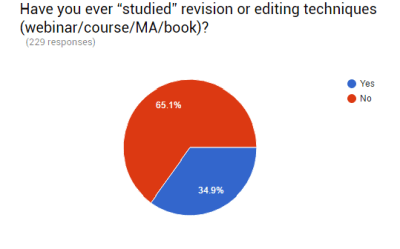 The very last question in my revisions survey (answered by 229 of the 232 people that filled it out) focused on finding out what, if any, training colleagues have in revision techniques. Out of the 80 people who responded yes to this question, 77 went on to give me the details (thank you!).
 I’d always planned to become a translator. The career seemed to fit my abilities and interests well so the die was cast on my academic path. The translation modules I did as part of my undergraduate degree in Modern Language Studies (French, Spanish and Dutch) only whetted my appetite further for continuing my study of translation. Then, as if almost by a stroke of fate, just as I was starting my final undergraduate year, the university’s Cultures, Languages and Area Studies department announced that they would be introducing a postgraduate programme in Translation Studies – with the option to study interpreting as a supplementary module. I leapt at the chance to apply for a place as soon as I could, and so began my
  Today’s guest post is by Deepti Limaye and it’s our second on an MA course outside Europe.
 As I sat on a boat to Hvar, Croatia, knowing that I wanted to leave my job and mulling over the options available to me, I had my lightbulb moment: “I know,” I thought, “I’ll go back to university to study for a Masters in translation.”
 In 2011, I found myself in the same situation as many other students: nearing the end of my undergraduate degree – in my case, a BA (Hons) in French and Spanish – and unsure of what to do next. I had really enjoyed the translation modules during my course, so I decided to continue down this road, and, a few months later, began my year-long
  Tranix Translation & Editing Services