
 When meeting colleagues in person, we invariably talk shop within seconds. Obviously that’s hardly surprising, yet I am often taken aback by just how quickly mention of Linguee can crop up in the conversation. For many it seems to be the first port of call when a term in their translation has them stumped. For me, however, even though my Google searches often return a number of Linguee hits, it’s a site I now largely ignore (and judging by a conversation I had on Twitter yesterday, I’m not alone). Perhaps Linguee is better for some language combinations than others (mine is Spanish to English), but since I discovered Reverso, I haven’t really looked back.
Bite-sized Tips No. 21: Spellings Part 16 – Getting Trickier Every Time
Spellings Part 16 – Getting Trickier Every Time
 Here are today’s ten words, which, as ever, are based on the spellings I find in the New Oxford Style Manual or the Oxford English Dictionary (OED). Regular readers will know that, in the absence of alternative instructions from my client, I base my translations into English on Oxford.
Given that we are bombarded with not only different versions but also varying levels of written English on a daily basis, my brain cells can get a trifle confused on occasion, so I look words up just to make sure that I’m being faithful to the style I have chosen to follow and can answer any queries (if any come my way) on why I have chosen to spell a word a certain way.
What a difference an MA makes: the MAATS at Leeds

I graduated from Leeds’ Centre for Translation Studies in 2012, having taken the MAATS (MA in Applied Translation Studies) Masters.
I was somewhat atypical in my cohort as I had already completed a year working as an intern translator in a small (or pocket-sized) agency in Castres, Southern France. As such I was already well accustomed to translating huge amounts of text, translating to deadlines, and working on my own as well as with editors and proofreaders. I continued to work freelance as a translator for my former employer throughout my Masters, which did help me to keep some perspective on my studies.
Since graduating with my MA in hand, I have gone on to work at Google, more freelancing, and am currently an Account Manager at Wordbank, a London-based marketing translation agency. I think the fact of having a Masters helped me win these roles (and keep them!) for sure. But has what I learned at Leeds made any difference? Here are some great things about the MAATS course at Leeds (they also offer interpreting, audiovisual translation, and PGDips which I am not able to comment on, really).
My ideal purchase order: pipe dream or reality?
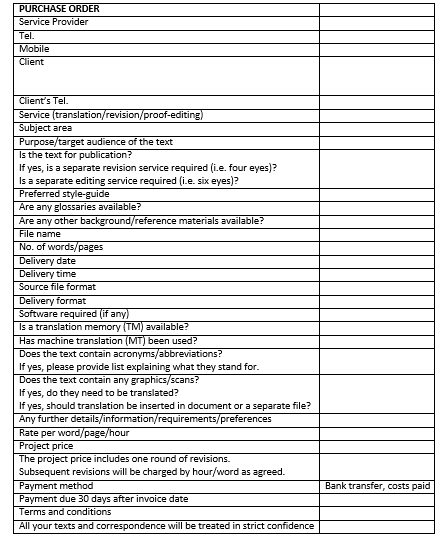
May 2021 update: The purchase order has been updated. Please see this post for 4 new versions of it (for translation, revision, editing and localisation), which you can also download here.
For a while now I’ve been working on the type of purchase order I’d like to give to both my agency and direct clients (especially new ones) so that we all know where we stand and are clear about the price and what it does and does not include. Today I’ve been inspired by reading Two to Tango: Tips for Project Managers from a Freelance Translator (parts 1 and 2) by Igor Vesler on Lingua Greca’s blog to finally finish my first draft. I’m posting it here so I can get your feedback and comments, because I’m a little concerned that it might be overly long and put some clients off.
My Tailored Sitting/Standing Desk Set-up
Today’s guest post has been written by Allison Klein who I first connected with on Facebook and later had the pleasure of meeting IRL last October at the MET 2014 conference. Enjoy!
First of all, I would like to say how thrilled and honored I was to have been asked by Nikki to write a guest post for her blog. This idea came about after I had posted something on social media about my quest to find the ‘perfect’ sitting-standing desk and chair earlier this year, and Nikki suggested I blog about it, and here we are.
The Why
This type of set-up is something I have actually been thinking about for a couple years now, between all the attention in the media about how a sedentary lifestyle, such as the one translators and many other professionals lead these days, can cause a range of health problems down the line.
Bite-sized Tips No. 20: Watch out for the Dragon
 If you use Dragon NaturallySpeaking (DNS) or another dictation software, you’ll probably have realised by now that it sometimes has a life of its own. That’s why you need to pay attention to spelling and that you are being faithful to whichever style manual you are following (either your own personal decision or dictated by the client), especially as the spellchecker in Word might not highlight spellings as wrong that are not consistent with your style guide. Regular readers will know that I base my work on the New Oxford Style Manual. From now on in this series I’ll be highlighting terms that DNS can get wrong.
Please read my post Why All the Fuss about Spellings and Style Guides? for an explanation of why I think it’s important to be consistent in our work and be aware of the types of details I focus on in the Bite-sized Tips series.
Bite-sized Tips No. 19: Spellings Part 15 – Another Ten
Spellings Part 15 – Another Ten

Here are another ten spellings that have cropped up in my translations/revisions and which I’ve looked up in the style guide I base my work on, the New Oxford Style Manual, to make sure I’m getting them correct. When this set of four books cannot give me a satisfactory answer, I then turn to the online version of the Oxford English Dictionary (OED).
There are a number of reasons why I focus my interest on spellings both on the blog and in my work, and if you’d like to know what they are, then please read my post Why All the Fuss about Spellings and Style Guides?. Links below the post will take you to other entries in the series, and you can also find a full list of all the past bite-sized tips posts here.
LinkedIn Pointers – Part Three: The “Meaty” Sections
This is the third part of my LinkedIn pointers miniseries. In the first we looked at the top of the page (photo, headline, etc.) and in the second we focused on connecting and netiquette. Today I’ll talk about the main part of your page on this important business site.

Tailor your profile order
The sections in the “meaty” part of the LinkedIn page used to be fixed in a particular order starting with the summary, but you can now arrange them as you prefer by just clicking the arrow in the top right corner of the section in question and dragging it where you want. This means you can highlight the parts of your profile that you feel are going to interest your potential clients the most and help you stand out from the crowd.
At the time of writing, I’ve decided to put the certifications section first to highlight the fact that I’ve now passed the ITI exam, followed by my experience and then the summary. If you have any certifications, it’s a good idea to put them in this separate section as the profiles of members that have done so apparently receive more views.
DipTrans: the Real Costs and Returns
This is a guest post by Gwenydd Jones.

This article will give you an idea of what getting the CIOL Diploma in Translation (DipTrans) from the Chartered Institute of Linguists cost me and the return I’ve enjoyed on my investment. It’ll help you anticipate what your own costs and returns might be if you sign up for the DipTrans exam in January to get this postgraduate qualification (the sign-up deadline is 30 September, with extension to 7 October).
A few words about using another’s translation for repeat texts
 I’m sure many of you can identify with this scenario: an end client sends an agency similar documents on a regular basis and most are largely the same with just a few tweaks needed here and there to incorporate new information. Sometimes this work is handled by agencies that farm the job out to the first available translator, provide them with a TM and tell them not to touch 100% matches (which they don’t pay for). Sometimes the agencies are quite happy for you to alter the TM and pay a sliding-scale revision rate for matches. Other times the agency sends the work to the same translator year after year, who can then use his or her own TM to do the job. However, in the latter case, the one I’m most familiar with, the preferred usual translator is inevitably not always available, so the document is sent to another translator to process along with copies of previous translations.
 Tranix Translation & Editing Services