This is just a short post to wish all my readers a very
Happy New Year!
And to take a quick look back at the gold, silver and bronze posts on my blog in 2016.

This is just a short post to wish all my readers a very
Happy New Year!
And to take a quick look back at the gold, silver and bronze posts on my blog in 2016.
 I started this post on Christmas Eve after yet another busy month on both the work and home fronts left me with very little spare time to think about writing for the blog. I always find in hard in December to keep up with everything because of the added stress of buying Christmas presents. And Christmas Eve was no exception as I made a frantic dash for the shops only to discover that one of the gifts I wanted to get my husband from M&S was already cellophaned up with a lower price tag for the Boxing Day sales.
But I mustn’t get ahead of myself. This is a post about November. The month that saw Trump elected to the White House. After Brexit didn’t go the way I hoped, I guess I shouldn’t have been shocked. Although I know many think the same way I do, it is still hugely upsetting to see another side win that makes me fearful for the future, because the ramifications of the Brexit and Trump victories will undoubtedly be felt worldwide.
 We started working as freelancers in the translation industry just over a year ago. As we both have a similar background (we graduated with the same master’s degree, TSM—Traduction Spécialisée Multilingue—from Université de Lille 3, North of France) and we completed an internship in the same SME, we thought this post would be a good opportunity to look back and see to what extent our studies have impacted (and still impact) on our daily professional lives/careers.
To illustrate this point, we have decided to mainly focus on the second year of our MA, for the following three reasons:
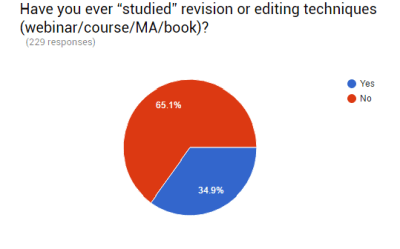 The very last question in my revisions survey (answered by 229 of the 232 people that filled it out) focused on finding out what, if any, training colleagues have in revision techniques. Out of the 80 people who responded yes to this question, 77 went on to give me the details (thank you!).
It’s nearly December now and here I am just getting around to writing about last month. Following weeks of working on one project after another, and being lucky enough for clients to agree to wait in the queue, I’m finally enjoying a bit of breathing space. Hopefully it won’t signal a famine period for me as I am only free because I couldn’t make the deadline for one largish project and didn’t fancy anything else I was offered.
 I’d always planned to become a translator. The career seemed to fit my abilities and interests well so the die was cast on my academic path. The translation modules I did as part of my undergraduate degree in Modern Language Studies (French, Spanish and Dutch) only whetted my appetite further for continuing my study of translation. Then, as if almost by a stroke of fate, just as I was starting my final undergraduate year, the university’s Cultures, Languages and Area Studies department announced that they would be introducing a postgraduate programme in Translation Studies – with the option to study interpreting as a supplementary module. I leapt at the chance to apply for a place as soon as I could, and so began my Master’s degree at the University of Nottingham.
 The third section of the revision survey switched to focusing on the perceived quality of a revision and satisfaction with a reviser’s job. But it kicked off with asking respondents whether they were aware of the definitions of reviser and revision in the standard ISO 17100:2015, and two thirds are apparently not.
It’s quite simple, really. A revision is the comparison of the source text and the target text (i.e the translation) by a second person, the reviser (and, therefore, revision does not refer to the check the translator makes of his/her own work). Click on the above link for more definitions of terms used in the translation process. I have also written about the differences between revision and proofreading here.
 Today’s guest post is by Deepti Limaye and it’s our second on an MA course outside Europe.
The Middlebury Institute of International Studies (MIIS), formerly known as the Monterey Institute of International Studies, offers four degree programs in translation and interpreting—MAT (Translation), MATI (Translation and Interpretation), MATLM (Translation and Localization Management), and MACI (Conference Interpreting)—in Chinese, French, German, Japanese, Korean, Russian, and Spanish. Some Portuguese translation and interpreting classes have also been offered since 2012. I finished the coursework for the MATI program in Spanish in May 2015, and will be graduating in December 2016, after defending my translation thesis.
 I’m posting this rather late because October has been another busy month for me work- and family-wise. It’s also been quite hectic on the blog with the start of the revision survey results (do check them out if you haven’t already. I’ve included as many comments as I can to show the range of opinions on the topic) and more MA review posts (on Cardiff and Westminster).
 As we saw in Part 1 of the Revision Survey Results, the main reason respondents gave for not offering revision services on their website or social media profiles (91 people explained their response) was poor translation quality. This was corroborated by the next survey question, shown above left.
 Tranix Translation & Editing Services